Route 41 at 100
US Route 41 Centennial: Naples to Copper Harbor, Then on to Miami
US Route 41 turns 100 in 2026. The anniversary marks a route designation approved with the U.S. Numbered Highway System on November 11, 1926—not every present-day mile, alignment, bridge, or endpoint.
The original route broadly connected Naples, Florida, and Copper Harbor, Michigan. Miami became part of US 41 later, when the route was extended south from Naples in 1949.
November 11, 1926
What the centennial marks
The U.S. Numbered Highway System received final approval on November 11, 1926. US 41 was part of that original system, so its route designation reaches its centennial in 2026.
1949
How the route reached Miami
AASHO approved extending US 41 from Naples to Miami in June 1949, replacing US 94 between those cities. That made Miami a later US 41 endpoint, not the original 1926 southern endpoint.
A route designation turns 100—not every modern mile
US 41’s centennial is an anniversary of the numbered route. The modern road trip includes later changes in route extent and many changes in alignments, roads, bypasses, bridges, and local approaches. It is useful to celebrate the continuity of the route story without treating the present Miami-to-Copper-Harbor drive as an unchanged 1926 roadway.
The original Naples-to-Copper-Harbor corridor
At map level, original US 41 broadly ran from Naples to Copper Harbor. Naples is therefore central to the original centennial story, while Copper Harbor remains its northern endpoint story. Those broad corridor facts do not establish that every modern local alignment between the endpoints has carried the designation continuously since 1926.
For a traveler, this original frame gives the route a useful north-south arc: Gulf Coast Florida, the South and Midwest, Great Lakes country, and the Upper Peninsula finish. Open the Route 41 overview when you are ready to turn that arc into an actual trip.
The Tamiami Trail and US 41 are related—but not identical histories
The Tamiami Trail was completed in 1928 as a Tampa-to-Miami road via Naples. Its road-building history matters to the South Florida chapter of Route 41, but it is not the same thing as the history of the US 41 number.
The Naples-to-Miami corridor was not part of original US 41 in 1926. It carried US 94 before the 1949 action that extended US 41 to Miami. Keeping those two timelines separate makes the modern South Florida opening easier to understand: the road existed before that segment received the US 41 designation.
From Naples to Miami: the 1949 extension
In June 1949, AASHO approved the extension of US 41 from Naples to Miami and the abandonment of US 94 between those points. Today, Miami is the starting city for Route41RoadTrip’s modern south-to-north planning frame, while Naples remains the original broad southern-endpoint anchor for the 1926 story.
That distinction helps travelers read the route as an evolving corridor: start in Miami for the modern Tamiami Trail and Big Cypress crossing, then understand Naples as the place where the original US 41 story began.
Eight states, one evolving route
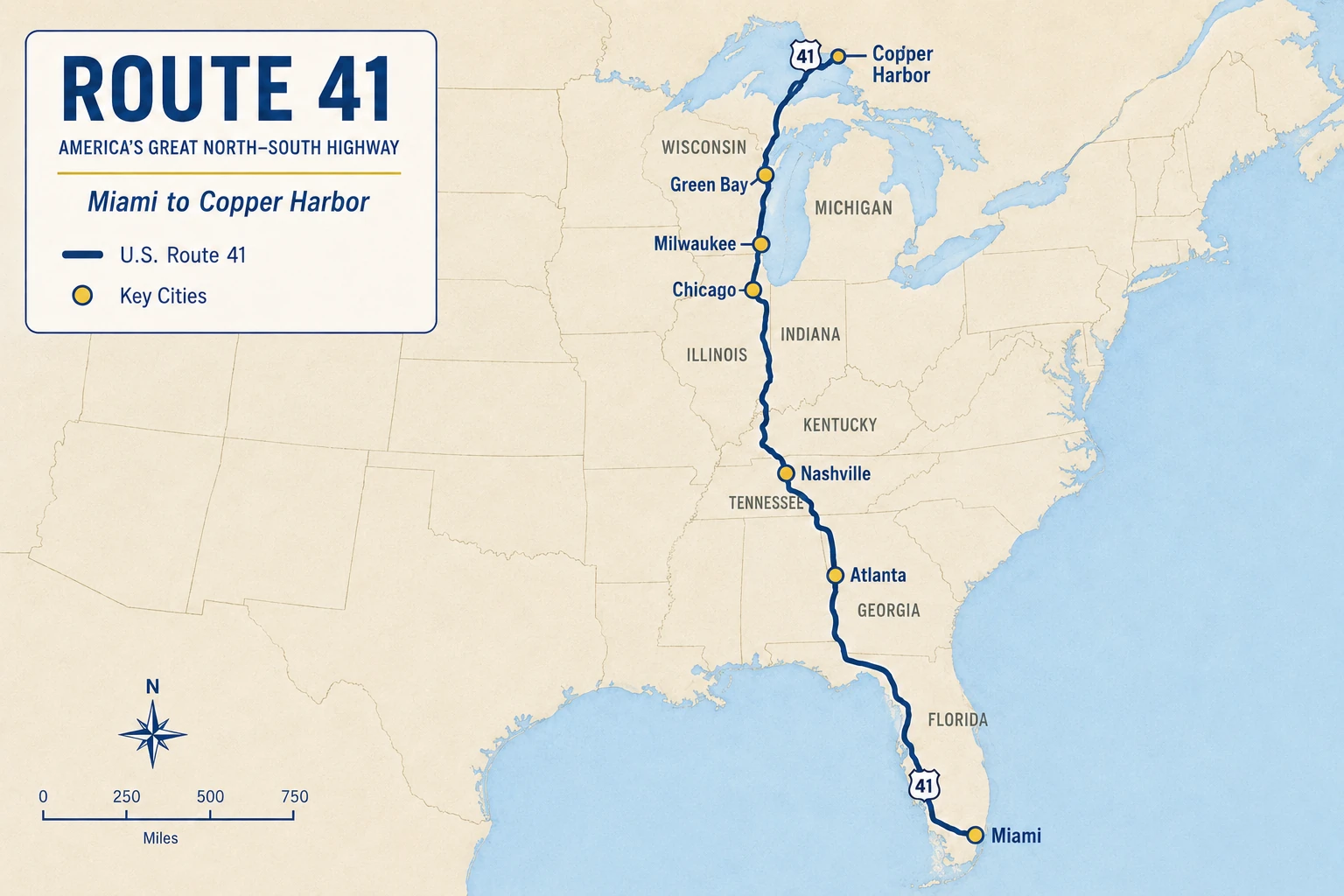
Route41RoadTrip follows the modern Miami-to-Copper-Harbor corridor through Florida, Georgia, Tennessee, Kentucky, Indiana, Illinois, Wisconsin, and Michigan. The route’s 100-year story is not a claim that every segment has the same age or history; it is a way to see how one numbered highway connects very different travel chapters.
Explore the eight Route 41 states
Three endpoint stories
Original southern anchor
Naples
Naples is the original broad southern endpoint in the 1926 US 41 corridor story and a practical Gulf Coast planning stop today.
Later extension
Miami
Miami joined US 41 in 1949 and is the modern southern start for planning the Tamiami Trail and the complete corridor.
Original northern anchor
Copper Harbor
Copper Harbor is the original broad northern endpoint story and the modern route’s prepared Upper Peninsula finish.
Plan the modern route
Use the current guide to shape the centennial story into travel decisions: start with the route overview, compare the eight states, choose from places, or open a manageable road trip. Those pages describe the present travel corridor; this page provides the historical frame for understanding how it developed.
Read the editorial companion
Readable route story
US Route 41 at 100
Read the editorial companion for a concise journey from the original Naples-to-Copper-Harbor route to the later Miami extension, then return here for the detailed history.
Compare the Roads of 1926
Shared numbered-system origin
Explore the Roads of 1926
US 41 shares its 1926 U.S. Numbered Highway System origin with US 17 and US 20. The three-route overview provides a quick comparison; return here for detailed US 41 history and route evolution.
Accuracy and source note
This guide uses the U.S. Numbered Highway System’s November 11, 1926 final-approval date, the 1926 system map’s corridor-level record of US 41, the 1949 AASHO action on the Naples-to-Miami extension and US 94, and National Park Service history of the Tamiami Trail. Route41RoadTrip is an independent travel-planning guide and is not affiliated with a centennial commission, highway association, tourism campaign, or government agency.
Useful after the anniversary
The 2026 centennial is a timely reason to look at US 41, but the route-evolution story remains useful after the anniversary. It explains why Naples and Miami have different historical roles, why the Tamiami Trail needs its own timeline, and how today’s Miami-to-Copper-Harbor trip fits a route designation with a century of changes.