Interstate bridge · I-75, I-41, and US 41
The Interstate can cover the miles. Route 41 can decide where the trip happens.
A Route 41 road trip does not require an oath to stay on the older highway for every mile. In Georgia, I-75 can be the pace layer while U.S. 41 identifies towns and older-road chapters worth slowing down for. In Wisconsin, I-41 often carries the through trip while local destinations determine when leaving uninterrupted freeway travel makes sense.
Same corridor, different jobs
Use speed deliberately, then slow down deliberately.
The goal is not to prove that the surface road is always better. The goal is to know which road serves the next part of the day.
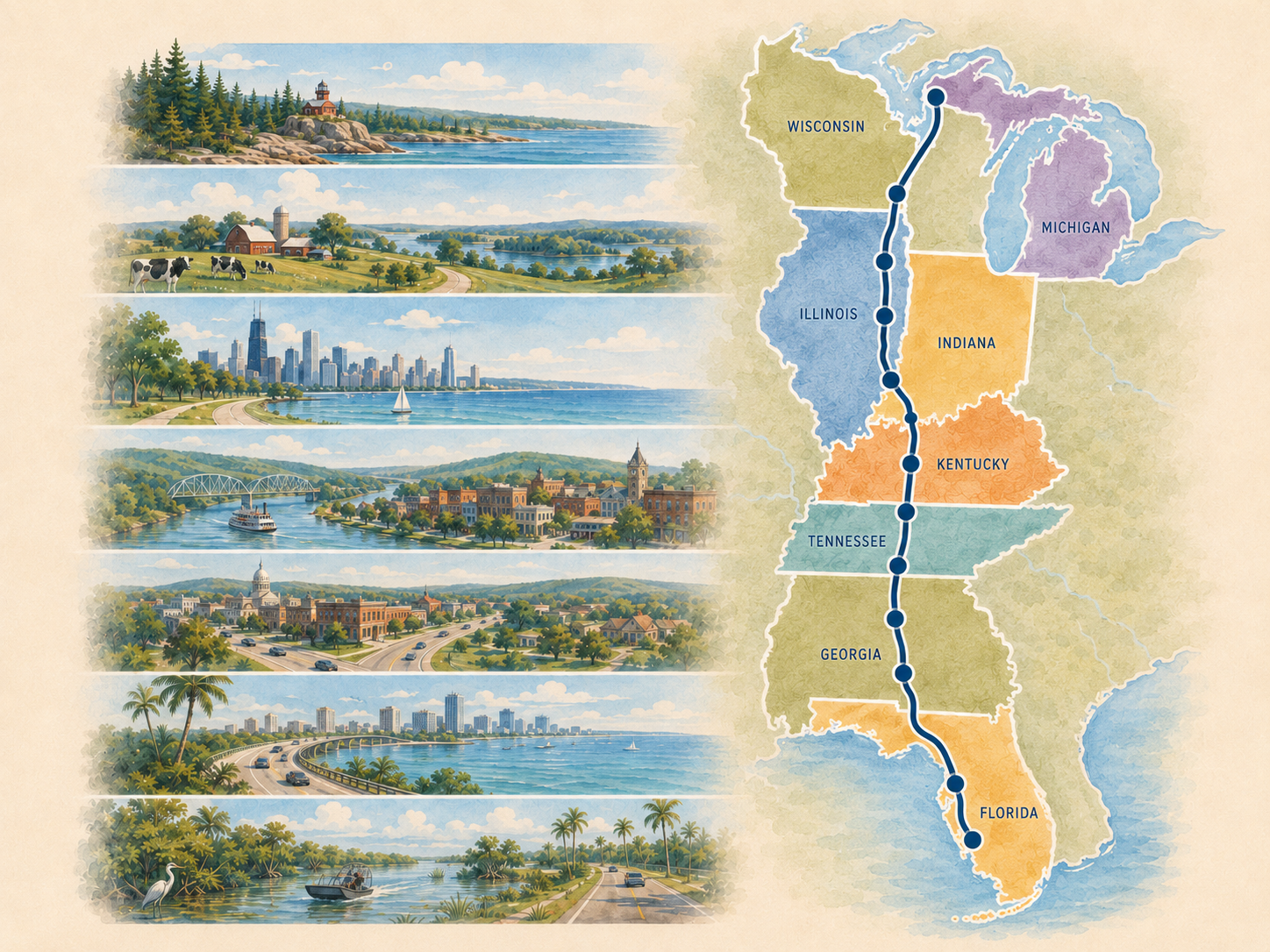
A hybrid Route 41 trip is still a Route 41 trip
Long corridors create competing needs. Some hours are about making distance. Other hours are about the place you came to see.
The Interstate is useful when the schedule needs speed, a city arrival needs protection, or a long regional transfer would otherwise consume the day. Route 41 becomes more useful when a town, historic road section, meal, city neighborhood, lakefront, riverfront, or overnight is the actual travel experience.
Pace layer
Let the Interstate do the repetitive mileage
Use the freeway when the trip is between destinations. There is no prize for adding slower mileage that does not improve the day.
Discovery layer
Let Route 41 choose the places
Use the route guide to identify which towns, city anchors, older-road stretches, and regional chapters are strong enough to earn time away from the freeway.
Georgia: I-75 for pace, Route 41 for selected stops
Georgia is the cleanest version of the strategy. I-75 and U.S. 41 occupy much of the same broad north-south travel geography, but they are not the same experience and should not be treated as interchangeable roads.
An interstate-first day can use I-75 to protect the schedule, then leave the freeway when Valdosta, Macon, Atlanta, or another Route 41 stop has a specific role.
Valdosta can be the first Georgia reset. Macon is strong enough to carry a substantial meal, cultural stop, half-day, or overnight. Atlanta should be planned before the final miles: it can be a destination stay, a Route 41 city passage, or simply the endpoint after an interstate mileage push.
The Lake City to Atlanta road trip already uses this logic explicitly. For the broader Georgia structure, use the Georgia state chapter and the South and Middle Georgia segment.
Wisconsin: I-41 can be the through route while the destinations stay local
Wisconsin is a different kind of Route 41 relationship. Here, I-41 can be the through-driving road through the Fox Valley, but the places a traveler wants to experience still require deliberate destination choices.
That means Oshkosh, Appleton, Little Chute, De Pere, and Green Bay should not be treated as one continuous roadside attraction. Choose the stop that solves the day.
- Pick a Fox Valley city when the trip needs a meal, walk, local attraction, or overnight.
- Use Green Bay when the city itself, a stadium-area plan, downtown or riverfront time, or a practical reset is worth the exit.
- Keep the freeway when the more important goal is protecting an Upper Peninsula arrival.
The Chicago to Copper Harbor trip shows how to use I-41 without losing the Route 41 destination layer. The Wisconsin state chapter and Wisconsin Lakefront and Fox Valley segment give the larger context.
The stop has to earn the slower mileage
A good interstate-to-Route-41 handoff usually fits one of four jobs:
Destination
Spend real time in one place
A city such as Macon or Green Bay works when the stop is substantial enough to change the day, not when it is just a pin on the map.
Older-road chapter
Choose the surface road for a reason
Use Route 41 when the road texture, town sequence, or regional identity is part of what you came to experience.
Reset
Break a long day intelligently
A meal, walk, service stop, or overnight can make the next mileage push better without requiring an all-day detour.
Through-driving
Keep moving when moving is the point
If the next destination matters more than the intermediate road, let the Interstate do its job and save Route 41 time for a stronger chapter.
Do not merge the route identities
I-75 travel is not U.S. 41 travel simply because the roads share a broad corridor. Likewise, driving I-41 through Wisconsin does not mean every nearby local destination sits directly on the freeway.
Keep the identities separate. Use the Interstate as one travel layer and the Route 41 guide as another. Switch between them because the itinerary calls for it, not because one road is supposed to be morally superior to the other.
Also keep current construction out of the evergreen strategy. Work zones, closures, traffic, and access change; verify those conditions before departure.
Start with the whole road, then choose one chapter
Whole corridor
Route 41 overview
See the Miami-to-Copper-Harbor road before deciding which sections deserve surface-road time.
State layer
Browse states
Use the state hub to move into Georgia, Wisconsin, or another chapter of the corridor.
Driving chapter
Choose a segment
Pick a bounded road section when one part of Route 41 is worth more attention than the full long-distance corridor.
Trip shape
Browse Route 41 trips
Use the trip layer when you want a realistic start, finish, and sequence of stops.